CS 3100: Program Design Paradigms
Lecture 1: Course Overview & Introduction to Java
©2025 Jonathan Bell, CC-BY-SA
Introduction
- Jon, Prof Bell, Prof Jon, Dr Bell, Dr Jon, etc…
- Research: Software Engineering, Program Analysis
- Open source contributor & project founder
Meet the TAs
[TA introductions]
Learning Objectives
- Understand the structure of this course and what will be expected of you
- Review the Systematic Program Design and Implementation Process
- Describe the context of Java in the historical development of OO languages and JIT runtimes
- Compare the Java runtime environment to Python
- Recognize Java syntax
- Understand the difference between core datatypes in Java: primitives, objects and arrays
Let's Start with a Story...
The 1950s
Computers exist, but programming them is... tedious.
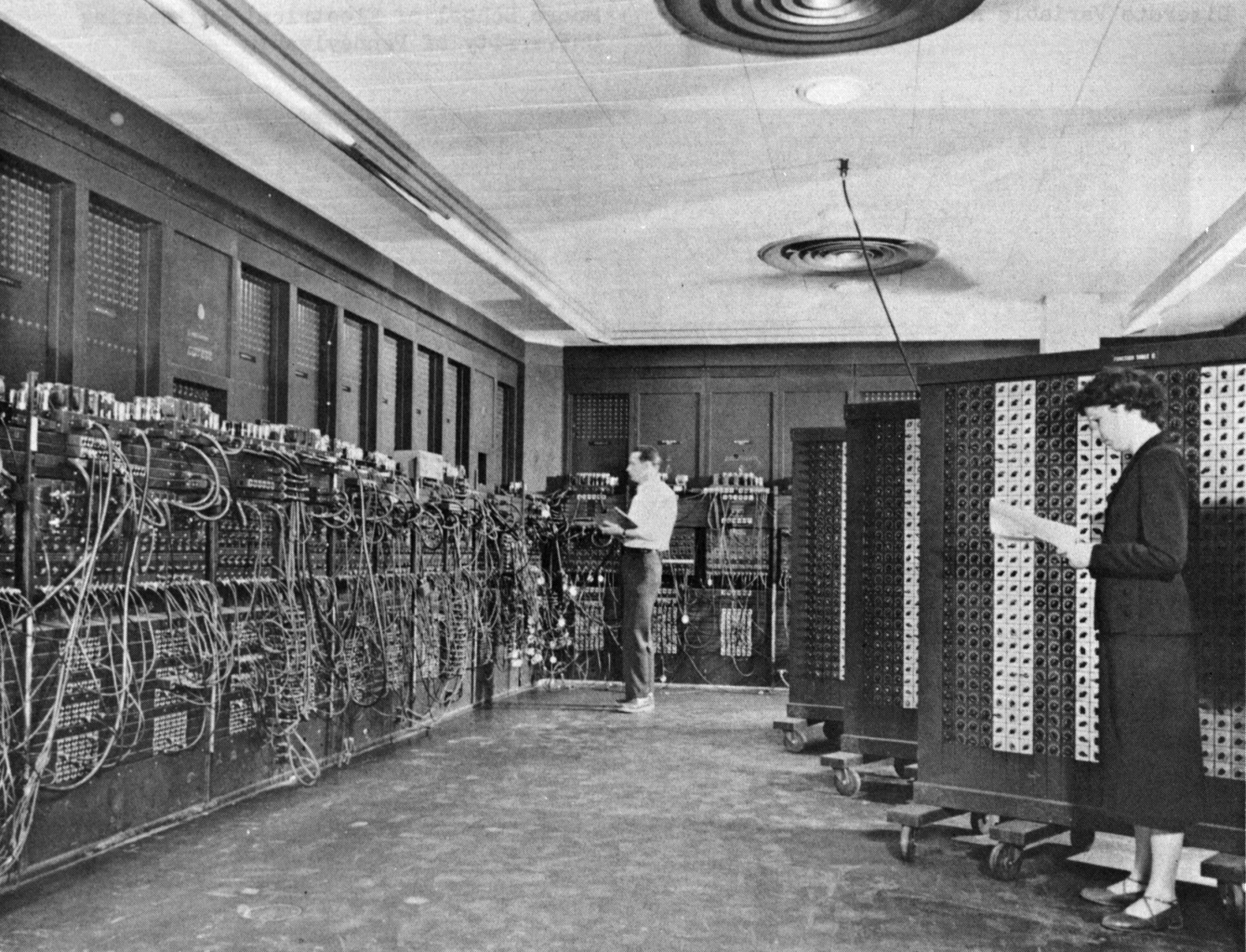
Glen Beck and Betty Snyder program the ENIAC (Public Domain)
1952: "Automatic Programming"
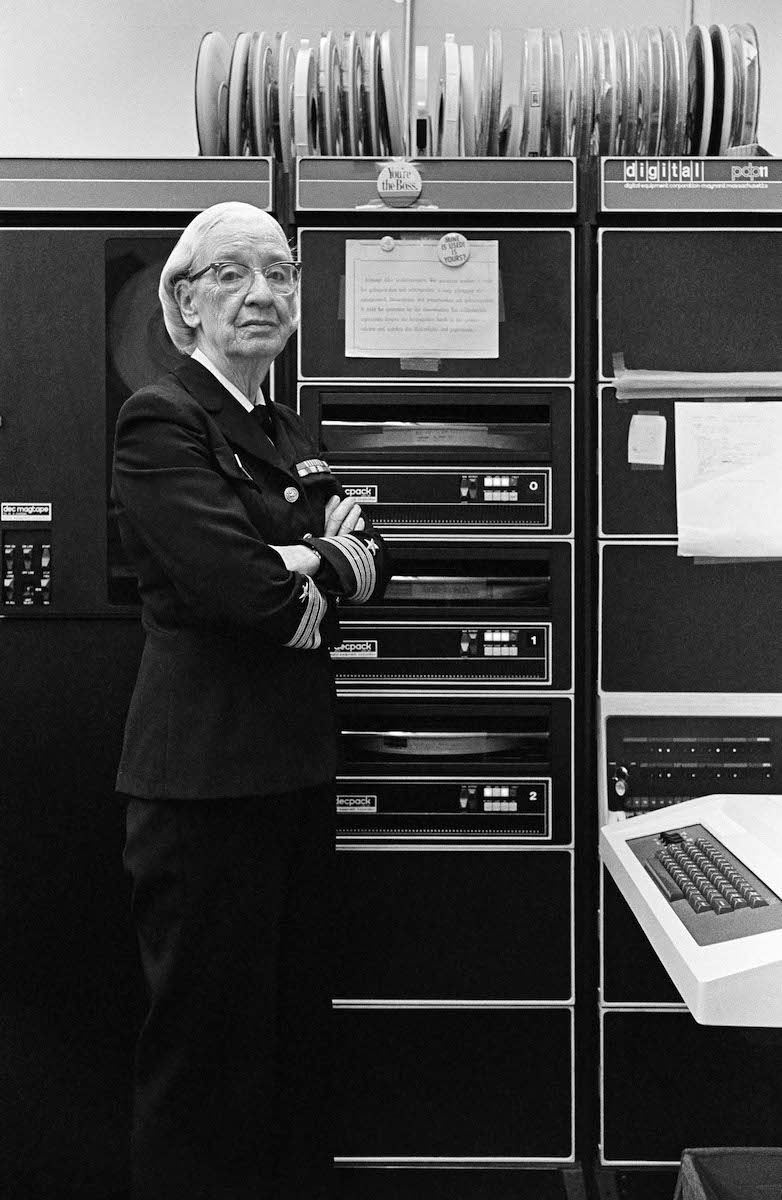
Grace Hopper develops the first compiler (A-0)
Her radical idea: let the machine translate human-readable code into machine code
The skeptics: "Machines can't write programs."
Photo: Lynn Gilbert, CC BY-SA 4.0
Sound Familiar?
"AI can't really write code..."
Every generation redefines what "automatic programming" means
Assembly → COBOL → C → Python → ???
1960s: Margaret Hamilton
Led Apollo flight control software — popularly attributed with origin of the term "software engineering"
"I fought to bring the software legitimacy so that it—and those building it—would be given its due respect."
Her "radical" approach: rigorous testing, error handling, treating software like hardware
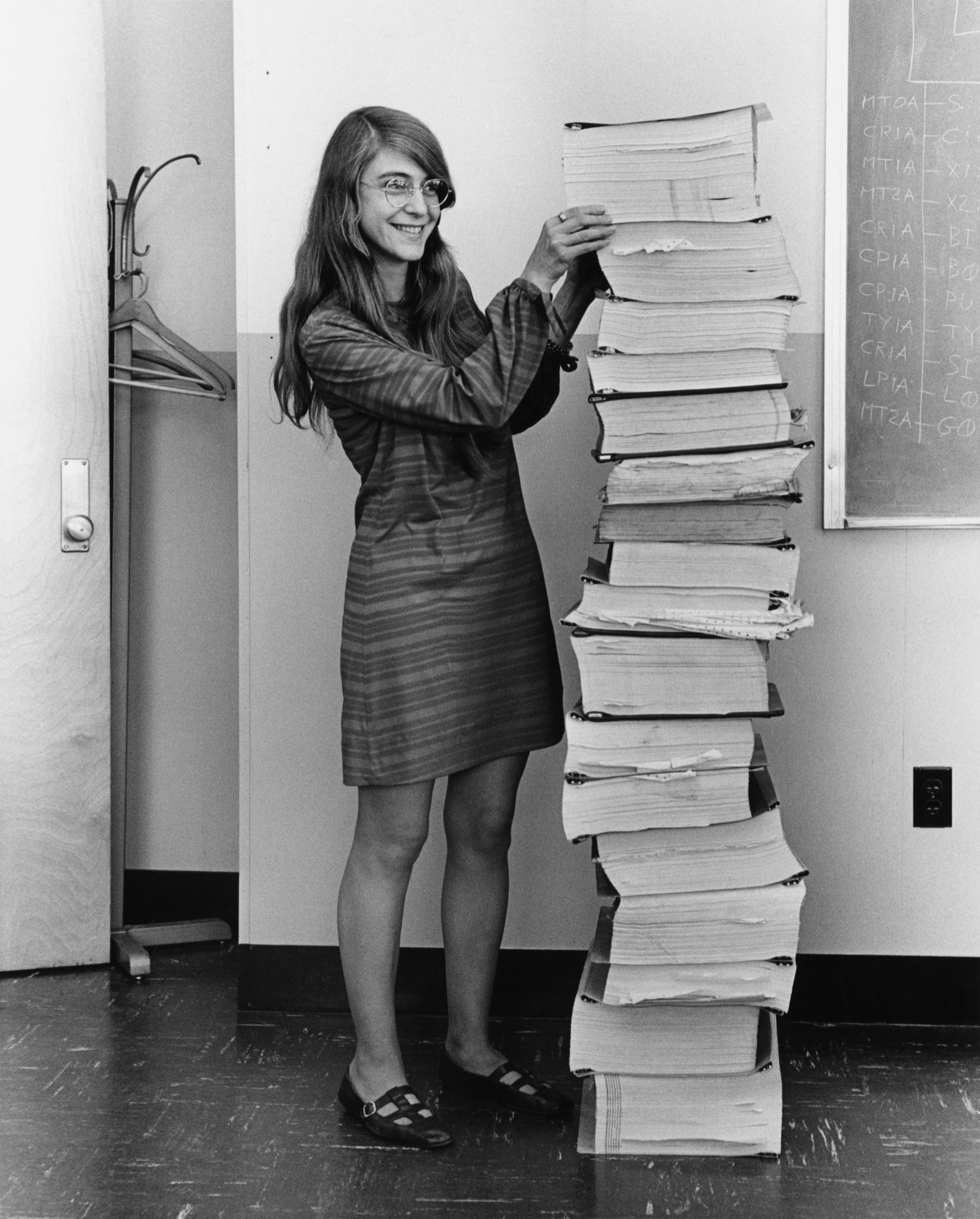
Margaret Hamilton with Apollo guidance software printouts (Public Domain)
The Software Crisis (late 1960s)
Despite innovations in programming:
- Software was very inefficient
- Software was of low quality
- Software often did not meet requirements
- Projects were unmanageable
- Software was, sometimes, never delivered
Something had to change
1968: NATO Software Engineering Conference
Garmisch, Germany — 50 experts from 11 countries
The term "software engineering" was deliberately provocative:
Software should be built with the same rigor as bridges and buildings
A formal call to action: we must study how to build software
The Key Outcome
There could be systematic techniques for writing software
Just as civil engineering has methods for building bridges...
...software engineering could have methods for building programs.
The rest is history: new processes, tools, languages, and paradigms emerged over the following decades — and continue to emerge today.
Did the software crisis end?

"The major cause of the software crisis is that the machines have become several orders of magnitude more powerful! To put it quite bluntly: as long as there were no machines, programming was no problem at all; when we had a few weak computers, programming became a mild problem, and now we have gigantic computers, programming has become an equally gigantic problem."
Photo: Hamilton Richards, CC BY-SA 3.0 · Quote: Dijkstra's 1972 Turing Award lecture
Moore's Law: 1972 → Today
Gordon Moore (1965): Transistor count doubles every ~2 years
From 1972 to 2025 = 53 years ≈ 26 doublings
≈ 67,000,000× more powerful
Dijkstra's "gigantic" is now incomprehensibly gigantic
This Course.
50+ years of research, practice, and hard-won lessons
How do we design, build, and maintain software that is sustainable at scale? (considering: technical, economic, environmental, social factors)
Using Java to explore ideas that transcend any single language
The Systematic Program Design Process
The goal: help you better understand how to design and implement programs
Inspired by classical software engineering processes
The Process
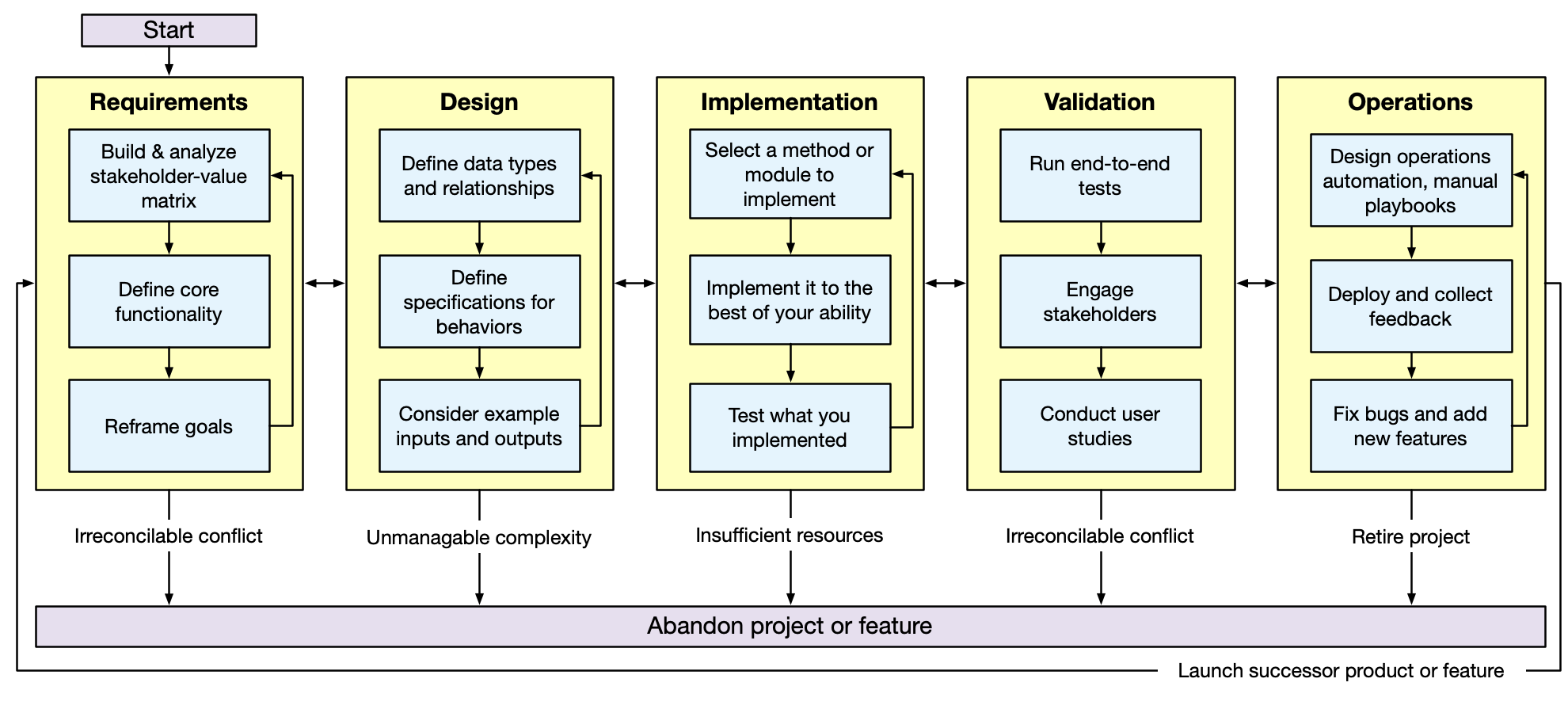
Requirements → Design → Implementation → Validation → Operations
Principles-Based, Not Syntax-Based
- We focus on the big picture and why things are the way they are
- Not just the syntax of the language
- Flashcards + resources provided for syntax—use them!
- We move quickly past syntax in lecture
What About AI?
The hardest parts of building software have never been typing code.
It's: understanding what to build, making tradeoffs, reviewing code, coordinating with humans
Early: AI restricted — you can't review code you couldn't write yourself
Mid-course: AI introduced with structured workflows for human-AI collaboration
We're all still learning what it means to program effectively with AI — let's figure it out together
Course Logistics
Deliverables: Assignments → final project • Quizzes • Exams • Labs • Participation
Participation (required for an A):
- Attendance + in-class polls
- Pre-lecture activities (flashcards)
Expectations: Do readings before lecture • Bi-weekly assignments ~20 hours
Do not wait until the last minute!
The 1990s: New Pain Points
- Platform fragmentation (Windows, Mac, Unix)
- The Internet
- 32,000× increase in complexity
C/C++ dominated, but:
- Manual memory management → crashes
- Platform-specific code everywhere
- "It works on my machine" 🤷
Java & Python responded with:
- Garbage collection
- Platform abstraction
- Large standard libraries
- Object-oriented design
Java vs Python: Same Problems, Different Philosophies
| Java (1995) | Python (1991) | |
|---|---|---|
| Origin | Sun Microsystems (corporate) | CWI research (community) |
| Types | Static — errors at compile time | Dynamic — errors at runtime |
| Speed | Fast (JIT compilation) | Slower (interpreted) |
| Style | Verbose, explicit | Concise, "readability counts" |
Discussion: If Java is faster, why use Python?
Where Are They Now?
- Android
- Enterprise
- Big Data
- ML/AI
- Data Science
- Scripting
Plot twist: Industry trending toward static typing
- PHP → Hack
- JavaScript → TypeScript
- Python → mypy
How Does Java Deliver on Its Promise?
"Write Once, Run Anywhere"
...with performance
The Challenge
- CPUs have different instruction sets
- OS's have different APIs
- How do you run a program on any machine?
The Bytecode Solution
Both Python and Java compile to bytecode
(an intermediate representation executed by an interpreter)
Sidebar: Is it really that easy? Ever compiled native Python extensions?
Interpreted vs Compiled
| Interpreted | Native Compiled |
|---|---|
| Reads & executes line by line | Already in machine code |
| 100s of instructions per statement | Direct CPU execution |
| Slower | Faster |
Compiler Optimizations
A compiler can:
- Identify branches never taken → remove them
- Inline small functions
- Optimize memory access patterns
An interpreter executes every line, every time
Java's Innovation: JIT Compilation
Just-In-Time (JIT) compilation
Dynamically compiles bytecode as it executes
The program that runs Java code: JVM (Java Virtual Machine)
Why Not JIT for Python?
PyPy and others have tried...
Fundamental language design differences
make it hard to match Java's performance
(Dynamic typing makes optimization very hard)
Tool Mapping: Python → Java
| Python | Java |
|---|---|
pip | gradle |
pytest | junit |
| VSCode | IntelliJ IDEA | VSCode |
Key Difference: Compilation
Python
Source → Interpreter
Java
Source → Bytecode → JVM
Java requires an explicit compile step
Discussion
Did anyone have Python experience before CS 2100?
(without mypy)
How did you find errors in your code?
Java Syntax: A Brief Tour
We won't teach syntax explicitly in lectures
But for this first lecture...a quick introduction
Hello, World!
package io.github.neu_pdi.cs3100.lecture2;

import io.github.neu_pdi.cs3100.utils.OtherClass;

/**
* This is a simple program that prints "Hello, World" 10 times.
*/
public class HelloWorld {
  public static void main(String[] args) {
      OtherClass other = new OtherClass(10);
      for (int i = 0; i < 10; i++) {
          // Print a message to the console
          System.out.println("Hello, World #" + i);
      }
      other.doSomething();
  }
}
Package Declaration
package io.github.neu_pdi.cs3100.lecture2;
- Similar to Python modules
- Convention: reverse domain name
- Example: GitHub user
octocat→io.github.octocat
Import Declaration
import io.github.neu_pdi.cs3100.utils.OtherClass;
- Imports classes from other packages
java.lang.*imported by default- → No need to import
String,System, etc.
Comments
// Single line comment

/* Multi-line
 comment */

/**
* Documentation comment (Javadoc)
* Used to generate documentation
*/
Class Declaration
public class HelloWorld {
  // contents here
}- All code must be in a class
public→ usable by other classes{ }delimit scope (not indentation!)
Method Declaration
public static void main(String[] args) {
  // method body
}
public | → accessible by other classes |
static | → class method (no instance needed) |
void | → returns nothing |
main | → JVM entry point |
Dissecting a Statement
System.out.println("Hello, World #" + i);System→ class injava.langout→ static field of typePrintStreamprintln→ method that prints + newline+→ string concatenation;→ required! (not Python)
A Supporting Class
public class OtherClass {
  private int x;

  public OtherClass(int x) {
      this.x = x;
  }

  public void doSomething() {
      System.out.println("Doing something with x = " + x);
  }

  public int getX() {
      return x;
  }
}
Key Syntax Points
private int x→ field only accessible within class- Constructor has same name as class
this.x→ refers to the field (not parameter)- Can have multiple constructors (unlike Python)
getX()→ getter method (encapsulation)
Java Data Types
Two categories:
- Primitive types (values)
- Reference types (pointers to objects)
Primitive Types
| Type | Size | Values |
|---|---|---|
byte | 1 byte | -128 to 127 |
short | 2 bytes | ±32,767 |
char | 2 bytes | Unicode character |
int | 4 bytes | ±2 billion |
long | 8 bytes | ±9 quintillion |
float | 4 bytes | ~7 decimal digits |
double | 8 bytes | ~15 decimal digits |
boolean | 1 byte | true / false |
⚠️ Big Change from Python
Integers have fixed sizes!
Python integers can be arbitrarily large
Java integers overflow at their limits
Quick Math: Memory Sizes
1 byte = 8 bits → = 256 values
4 bytes = 32 bits → ≈ (billions)
8 bytes = 64 bits → ≈ (quintillions)
Trick: ≈ (1,024 ≈ 1,000)
Why Does Size Matter?
Storing age (in years) for 8 billion people:
byte(1 byte) → 8 GBlong(8 bytes) → 64 GB
Memory was expensive in the 1990s!
Today: matters for big data (numpy, pandas are C extensions)
Reference Types
- Objects (anything extending
Object) - Arrays (e.g.,
int[],String[]) - Can be
null(no object)
Variables store a pointer to memory
Reference Equality Warning
String a = new String("hello");
String b = new String("hello");
System.out.println(a == b);  // false!
== compares references (memory addresses)
Not values like in Python
Use .equals() for value comparison
Arrays vs Python Lists
| Java Array | Python List |
|---|---|
| Fixed size | Dynamic size |
| Single type | Mixed types |
| Contiguous memory | Pointers to objects |
Summary
- Course: principles-based, large-scale design
- Java: "write once, run anywhere" with JIT performance
- Static typing is winning the industry debate
- Primitives vs references: understand the difference!
Next Steps
- Complete the pre-lecture flashcards
- Read: A Short History of Java (Horstmann)
- Lab 1: Java setup and first program
Questions?